Why Kanlıdivane helps us see Mersin beyond the coast
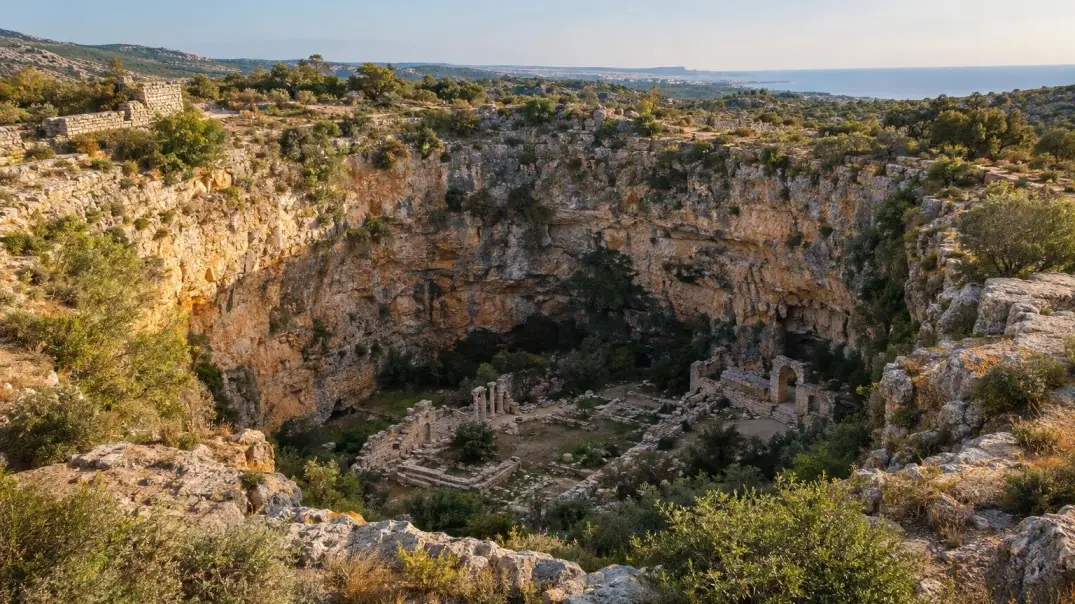
About 50 kilometers west of Mersin, in the Erdemli, lies Kanlıdivane, an archaeological site with ruins arranged around a massive natural sinkhole. It's not just the unusual topography that's worth exploring: the layout of the ancient settlement, the remains of roads, cisterns, and monuments reveal how people lived and managed their lives in this part of the Mediterranean.
For those settling into Mersin or choosing it as a long-term residence, such trips provide a more comprehensive understanding of the province. Mersin is more than just its waterfront and modern neighborhoods: beyond them lie historical sites and landscapes that can be reached on a separate trip. Kanlıdivane is best viewed as a standalone cultural destination, rather than a short stop on the way to the beach.
The settlement around the sinkhole: what is known here
The archaeological site developed around Kanlīdivane, a large karst sinkhole. The current website of the Ministry of Culture Museum lists its dimensions as approximately 142 meters along its long axis and 95 meters along its short axis, with a depth of approximately 50 meters and an area of approximately 12,000 square meters. These data help to visualize the scale of the landscape, but on-site, the contrast itself is more important: the steep center and the settlement traces located around it.
According to the museum, the site has been inhabited from the Hellenistic to the late antique period—roughly from the 2nd century BC to the 7th century AD. A discovered wall of polygonal stone blocks indicates the existence of a fortified settlement during the Hellenistic period. This is not a reconstruction of the entire city, but archaeological evidence that allows us to piece together its history.
Kanlıdivane is particularly interesting because the monuments here aren't gathered in a single building or museum hall. They're spread out across the open landscape, and the gaze constantly returns to the chasm. Therefore, it's helpful to allow yourself time to explore: first, take in the big picture, then notice individual architectural details, and only then try to integrate them into a picture of everyday life.
Workshops, cisterns and the road to the sea
Archaeological finds suggest more than just the settlement's religious or defensive functions. After clearing some of the buildings, researchers identified many of them as olive processing workshops. Numerous cisterns—structures for collecting and storing water—were also discovered in the surrounding area. These details are crucial for understanding the economy of the ancient settlement, especially in an area where access to water and its supplies was of practical importance.
The museum also points to Kanlıdivane's connection to the ancient harbor of Akkale. Near Church No. 3, a stone-paved section of the Roman road has become more visible. Taken together, these facts help us see not isolated ruins, but rather part of a larger system: the settlement, economic activity, and the route to the coast were interconnected. This is a reasonable interpretation of the archaeological data, not a promise that the entire ancient route is preserved for walking.
At the site, it's worth looking for more than just the most visible remains. Pay attention to how the rooms are positioned relative to the sinkhole, where stonework is visible, and how the surface changes around the ancient road. Don't attempt to descend the crumbling areas or go beyond the fences on your own: the experience isn't worth the risk to people and the monument.
How to plan a trip from Mersin
The museum's official website indicates that Kanlıdivane is located approximately 50 kilometers west of Mersin. The monument is reached by a roughly 3-kilometer-long branch road, extending north from the Yemişkumu neighborhood near Ayaş, part of Erdemli. The source doesn't provide reliable travel times or up-to-date public transportation schedules, so it's not recommended to plan your trip based on rough estimates from older publications.
Before leaving, check the current route in your navigation app and check separately what transportation is available to reach the branch point and whether it's possible to continue to the monument itself. If your trip depends on a bus, transfer, or taxi, check the return route in advance: the presence of a road to a landmark doesn't necessarily mean regular service to the entrance.
The museum's website lists opening hours as 8:30 AM–7:00 PM and a ticket office closing at 6:30 PM; the site is listed as open daily. Since opening hours and conditions are subject to change, please double-check before your visit, especially if you plan to arrive late in the afternoon. Don't expect arriving at ticket office closing time to leave enough time to explore the grounds.
Who is this place suitable for and what to consider
Kanlıdivane will appeal to travelers who enjoy archaeology, ancient history, and unusual natural formations. It could be a great cultural trip for Mersin residents looking to add more to their weekend than just the beach or a city stroll. For families with children, consider the length and nature of the walk in advance: this is an open archaeological site, not a completely leveled area.
- Bring water and sun protection: much of the examination takes place outdoors.
- Choose comfortable, closed-toe shoes for uneven surfaces; avoid walking close to the edge of the dip.
- Check current operating hours, route status, and return travel options before departure.
- Allow time to quietly explore the ruins, not just take a photo of the central pit.
- Do not touch the stonework or move objects: archaeological remains are vulnerable.
Kanlıdivane is one example of why exploring Mersin doesn't end in its central neighborhoods. The history of Erdemli and the western part of the province enriches the city's everyday image and helps better understand the diversity of places available for living and recreation. If you're considering a move, you can discuss not only your future neighborhood but also what cultural and natural attractions you'd like to explore within your weekend getaways.
The INCOME MERSIN team can help you navigate Mersin's neighborhoods and discuss the everyday aspects of city life. This discussion doesn't replace checking out the route and attraction opening hours yourself, but it can help you align your choice of accommodation with your usual lifestyle.
Sources and date of verification of information
Information verified on September 29, 2026, based on official publications at muze.gov.tr. Sources used for verification: Primary source: Location and access from Yemişkumu, sinkhole dimensions, occupation periods, fortified wall, olive processing workshops, cisterns, connection to Akkale harbor, Roman road, and published hours.