
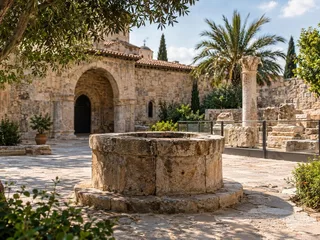
What is known about the Apostle Paul's Well in Tarsus?
Saint Paul's Well is a small historical site in the center of Tarsus, significant both as an archaeological site and as a site of Christian pilgrimage. It is associated with the house where, according to local tradition, the Apostle Paul lived. However, it is important to distinguish this tradition from proven archaeological evidence: the official description of the site speaks of a courtyard, commonly believed to be the site of Paul's house, and the remains of an older building discovered nearby.
For those who explore Mersin beyond its coastal location, Tarsus reveals another side of the province—a multilayered urban history and vibrant religious memory. A visit to the well helps understand why this site retains its significance for believers and simultaneously attracts those interested in history and archaeology.
The legend of Paul's house and archaeological finds
The official description by the museum administration identifies Tarsus as Paul's birthplace. The connection between a specific courtyard and his house is a matter of tradition and does not, in itself, establish the identity of the building discovered.
Archaeological work near the well revealed the remains of an old structure and cultural layers dating back to the era associated with Paul's life. The discovered architectural elements are protected by a covering to reduce the effects of the weather. Therefore, visitors see not only the well as a standalone object but also the archaeological site, demonstrating that the courtyard was used and changed over a long period.
Why do pilgrims come to the well?
The well is revered not only as an archaeological site. The official description states that Christian pilgrims consider its water holy and healing. This is a statement of religious belief, not a medical claim: the water is not described as a cure, and such properties cannot be interpreted as proven fact.
Where is the monument located and how to plan a visit
St. Paul's Well is located in the Kızılmurat neighborhood in central Tarsus. The address listed under "ST. PAUL KUYUSU ÖRENYERİ" on the museum administration website is: Kızılmurat Mahallesi, Dr. Edip Uğurcan Kürklü Sokak, No:39, Tarsus/Mersin. The Turkish Museums card lists a different address: Kızılmurat Mahallesi, St. Paul Meydanı No:1, 33400 Tarsus/Mersin. This address information refers to the well; the address of the museum administration and the address of St. Paul's Church refer to different locations. Before visiting, compare the official card and the location on the map.
The monument itself is best viewed as a historical space with a well and archaeological remains, rather than a large museum with vast halls. If you're counting on a guided tour, an exhibition, or a detailed interpretation of the excavations, you should check these conditions separately; they aren't confirmed in the official descriptions we've reviewed. Also, don't rely on opening hours or ticket prices from third-party publications—visit conditions are subject to change.
A calm and respectful approach to the site is appropriate. The archaeological sites are protected, so please do not go beyond the fences or touch the masonry or exhibits. If the religious significance of the site is important to you, keep in mind that it is both a cultural heritage site and a pilgrimage site: respectful behavior helps preserve it for a variety of visitors.
How to Include a Well in Your Mersin Experience
Tarsus is part of the province of Mersin, but its historical character is markedly different from the everyday image of the coastal areas. St. Paul's Well offers a unique opportunity to explore the city through archaeology, early Christian history, and cultural memory. For future Mersin residents, such trips aren't a must, but a way to better understand the diversity of life within a single province.
What's useful to remember before your visit
- Respect the pilgrimage significance of the site; ideas about the properties of water are related to religious beliefs.
- For navigation, use the official address in the Kyzylmurat quarter, and check opening hours and visiting conditions immediately before your trip.
Sources
- Ministry of Culture and Tourism: Mersin Tarsus Müze Müdürlüğü, section ST. PAUL KUYUSU ÖRENYERİ — archaeological information and address of the well.
- Turkish Museums: Mersin St. Paul's Well — description of the monument and alternative address.
The pages listed were reviewed during editorial review on November 1, 2026. Current visiting conditions have not been directly clarified with the administration.