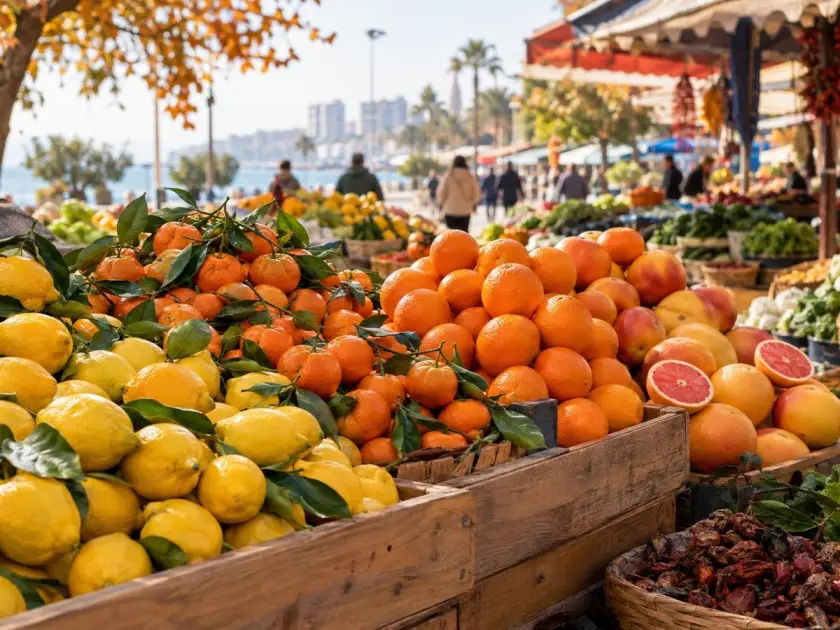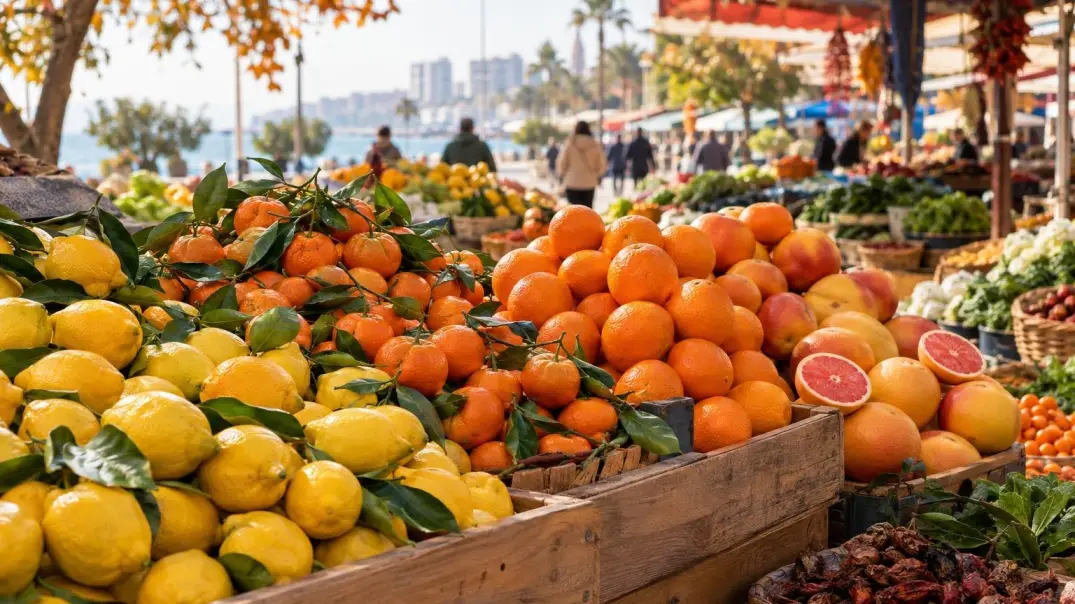
The autumn food season is part of everyday life in Mersin
In autumn, city shopping becomes a great way to get a feel for the local scene: what's on the shelves, what produce is grown locally, and how easy it is to fit a market visit into a typical day. In 2026, the Mersin Agriculture and Forestry Directorate announced the completion of an assessment of the expected citrus harvest. The publication named four crops: lemon, mandarin, orange, and grapefruit.
For those who have just moved to Mersin or are planning a long-term stay, this news is useful not as a price forecast, but as a reason to take a closer look at the local produce season. The market here is not a tourist attraction, but a familiar way to buy fruits and vegetables, compare the selection, and gradually gain an understanding of the local cuisine.
What is known about the 2026 citrus harvest?
The July 31, 2026, announcement states that the regional harvest estimate was based on field data and discussed with district specialists and representatives of relevant organizations. However, the published report does not include numerical forecasts for individual crops. Therefore, it cannot be interpreted as confirmation of a specific harvest volume, the availability of a particular variety, or future prices.
Another, historical figure is important for scale: the directorate's official briefing for 2024, citing TÜİK data for that year, states that the province of Mersin, covering an area of 377,863 decares, produced 1,430,456 tons of citrus fruit—approximately 26% of the national production stated in the document. This data is for 2024, not the 2026 harvest. It explains why citrus fruits are prominent in the local economy and seasonal assortment, but it does not replace a new report with actual results.
The practical conclusion is simpler: in October and subsequent months, it makes sense to monitor the product range in specific markets rather than relying on a single general forecast. Product availability, origin, variety, and price may vary from location to location and fluctuate throughout the season.
How to buy fruit at Mersin markets
If you're used to shopping at the supermarket, your local market may seem less predictable: the selection changes, the names of varieties aren't always obvious, and vendors offer different variations of the same product. This isn't necessarily a reason to buy more. It's a good idea to start with a small amount, sample the flavors, and then decide what's right for your home.
- Compare several shelves, rather than making a decision based on the first price or appearance of the product.
- Ask the seller about the origin and variety if where the product was grown is important to you. Don't automatically assume that every product is local.
- Choose fruits for a specific purpose: eating, juicing, cooking, or storing. Size and color alone don't answer all these questions.
- Check several fruits from different parts of the box if you are buying more than one piece: the appearance of the top layer does not always indicate the condition of the entire batch.
- Find out how the seller calculates weight and price, and check the total purchase before leaving the store.
- If you're just getting your bearings in the city, write down the address and opening day of the market that suits you, but before returning, double-check the schedule with the municipality or on-site.
These steps don't require any prior knowledge of the Turkish market or any special skills. Simply start with a small selection of products and compare where it's most convenient for you to shop: street vendors, a local store, or a supermarket. For permanent residence, it's often more important than a single large market, but how easily you can access your usual shopping from home.
What to look for when storing
Don't buy a whole month's supply just because the season seems short. First, assess how much fruit your family actually consumes and whether you have adequate storage space at home. At high room temperatures, fruit can deteriorate more quickly, so it's a good idea to save some of your purchase for the next few days and store the rest in a cool, dry place, inspecting it regularly.
Don't put damaged and undamaged fruit in the same bag: a damaged fruit can spoil the rest of the fruit faster. If you're renting, check that there's enough space in your kitchen cabinets or refrigerator for your regular supplies. This isn't a special "property inspection," but a simple way to assess how convenient the apartment is for everyday living.
Before buying large quantities, it's especially helpful to figure out what fruits your family actually uses. Some people need lemons for cooking, others like tangerines for snacking, and still others prefer oranges. A small trial purchase helps you choose the right amount without wasting anything.
Market and Neighborhood: How to Link Shopping to Your Daily Route
In Mersin, a neighborhood market may be part of a regular commute between home, work, the bus stop, or other daily activities. However, the mere presence of a market in a neighborhood doesn't guarantee that a specific apartment will be near it or that it's conveniently accessible. Check the exact address and directions on foot, especially if you plan to live without a car. Also consider the trading day: a weekly market is not a substitute for a daily store.
When viewing a home, it's helpful to assess not only the distance to grocery stores on a map but also the actual walking distance from your front door. Is there a convenient sidewalk? Do you need to cross a busy street? Is it possible to carry groceries home if you're traveling with a child or don't have a car? The answers depend on the specific building and street, so a general description of the neighborhood isn't a substitute for a short walk-through.
If you're choosing between a central city apartment and a more remote location, weigh the proximity of stores against other daily needs: healthcare and educational services, work, public space, and transportation. A market is just one element in this picture. For seasonal living, it can be a welcome addition, but if you're moving permanently, it's more important to consider whether regular shopping is convenient year-round.
What the official forecast doesn't promise
The harvest forecast publication does not indicate how much fruit will arrive at each market, what the prices will be, or how long the availability of individual varieties will last. It also does not guarantee that all produce sold in Mersin is grown in the province itself. If variety or origin is important to you, ask the seller and compare prices.
Don't draw broad conclusions about the cost of living in a city based on a single product or a single visit to the market. Daily expenses depend on family size, season, habits, where you shop, and where you live. It's better to visit different stores several times and record your own observations than to base your budget on a single ad or a one-time price tag.
Citrus season is a small but insightful way to experience Mersin through everyday life. It highlights the city's connection to agriculture, provides an opportunity to sample local produce, and evaluate the convenience of grocery shopping near your future home. When choosing an apartment in Mersin, this isn't the main criterion, but a useful part of the overall picture of the area.
If you're considering a move, INCOME MERSIN specialists can discuss neighborhoods and daily living needs with you—from access to shopping to familiar routes. Your choice should be based on the address and your goals, not your general impression of the city.
Sources and date of verification of information
Information verified on 21 October 2026. Official sources: Mersin'de 2026 Turunçgil Rekolte Tahminleri Belirlendi — 31 July 2026; 2024 Yılı Briefing — Narenciye Üretimi — statistics for 2024.